Spread, persuade, survive, win
Each race is a timed campaign on a real map against a better-known opponent. The clock stops whenever you open the upgrades or face a decision.
Before the race
- A way to play
- A career climbs from city council to the White House. A quick race is one race for any office. The Daily Race is the same race for everyone today, one try each. Scenarios are real races set up to teach one rule each.
- Your hometown
- Pick a state, then a county or town. Home starts out knowing you, and every place leans the way it really votes, so friendly ground is a head start.
- Your side and your platform
- Two made-up parties, one on the left and one on the right. Your platform is six stands, from the economy to social issues. Where you stand decides which voters warm to you: a stand far from the middle fires some up and puts others off.
- Your candidate
- Nine kinds of candidate, each with its own strengths and costs. Candidates and staff compares them.
- A difficulty
- Safe Seat is an open seat in a friendly year, Toss-Up an even race, and Long Shot a strong incumbent. Headwinds stack up to five extra challenges on top, from a sharper opposition to no time to think.
- The briefing
- Before the clock starts, the briefing shows this year's conditions, any special rules on the ballot, and the people you could hire. Bigger races have bigger staffs: one hire in a city or county race, two for governor or senator, three for president. Every hire helps one way and costs another.
A race, step by step
- 1
Get known
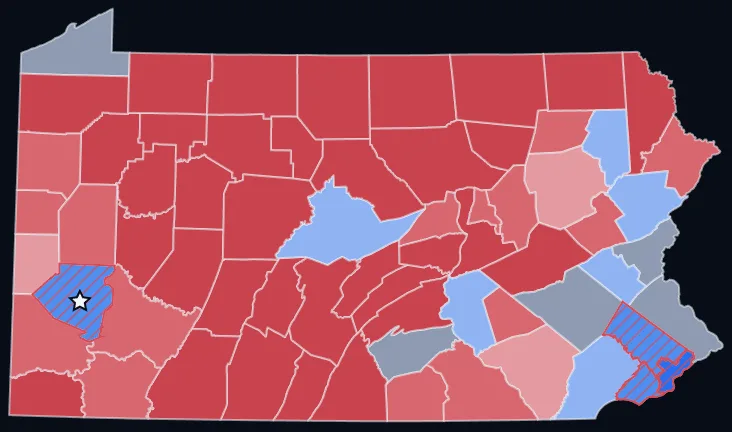
You start known only at home. Activists, radio, TV and social media carry your name outward, and a place has to know you before it votes for you.
View full-size screenshot - 2
Collect Political Capital
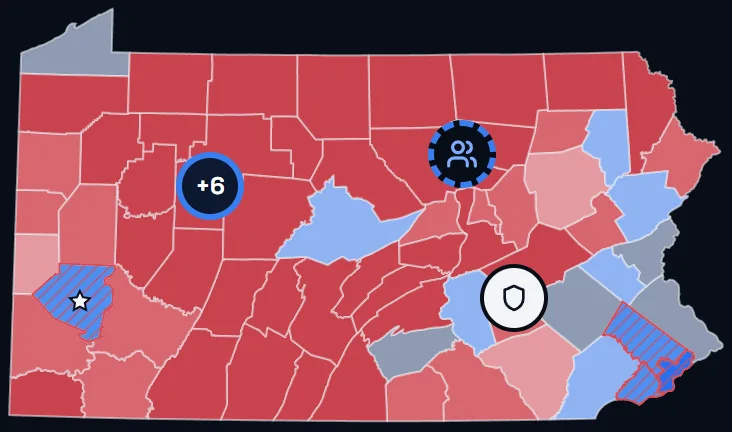
Tap the number bubbles for Political Capital. Ones with a dashed ring send volunteers where few know you; white shields slow the opposition's research.
View full-size screenshot - 3
Choose where to campaign
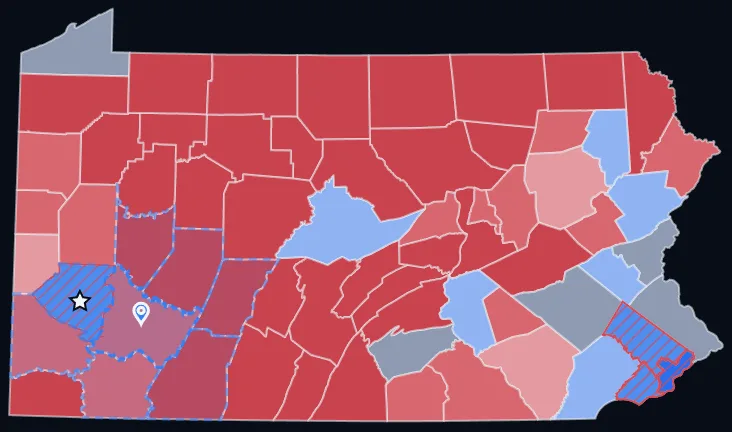
Tap a place and choose Campaign here: your candidate spends the week there, and the place and its neighbors get to know you. One stop at a time, so pick where the race is close.
View full-size screenshot - 4
Spend it on upgrades
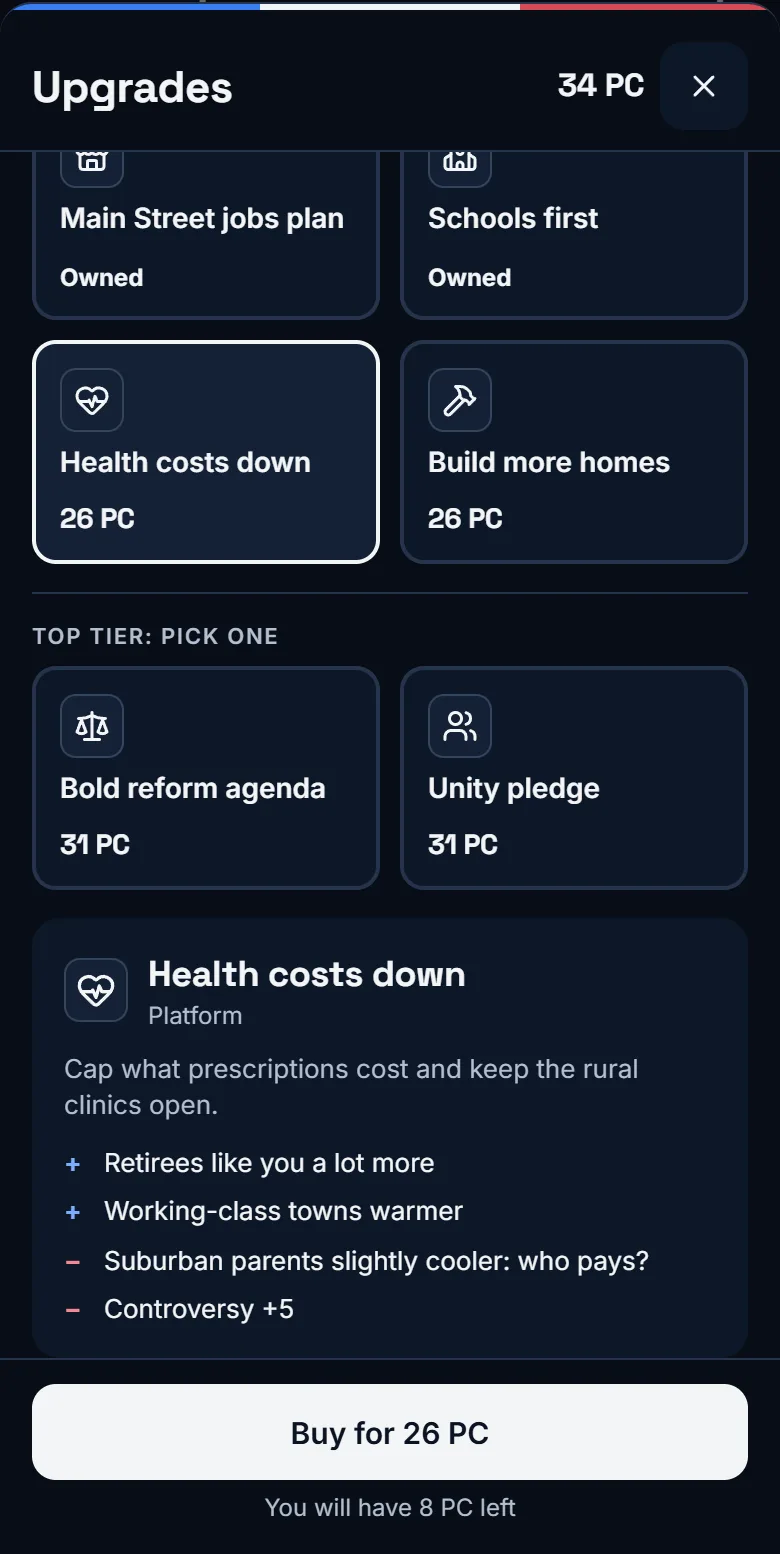
Three trees: Outreach, Platform and Machine. Almost every purchase raises the next price, and each tree ends in a pick-one choice.
View full-size screenshot - 5
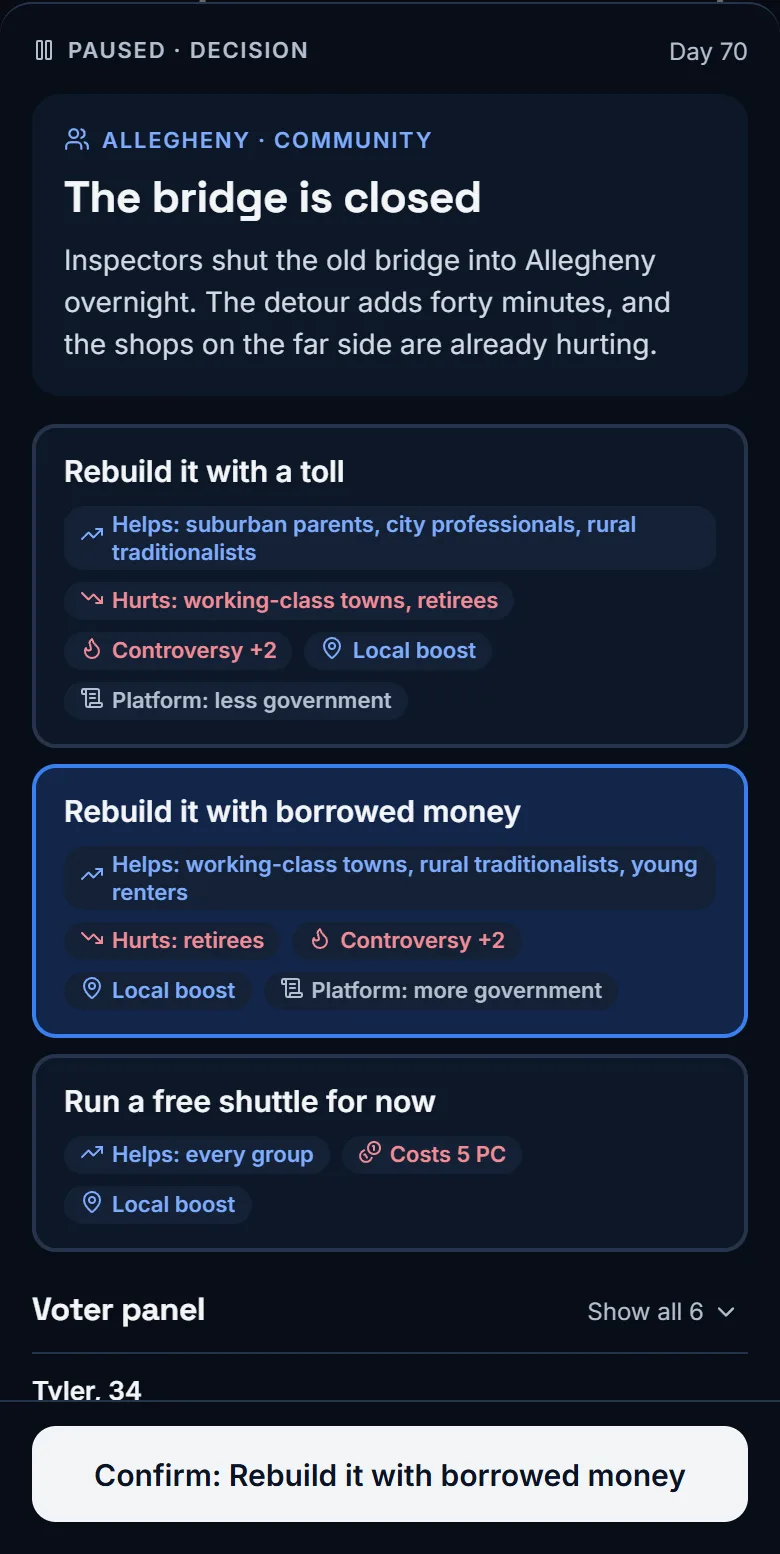
Make the hard calls
The clock stops for decisions. Each answer names the kinds of voters it helps and hurts, out of six, and shows what the papers will say. No answer is right everywhere: what works depends on where you are running. Now and then the world steps in: a storm, layoffs or a court ruling shows on the map for a few weeks, and some ask for an answer in place of your next decision.
View full-size screenshot - 6
Watch the opposition
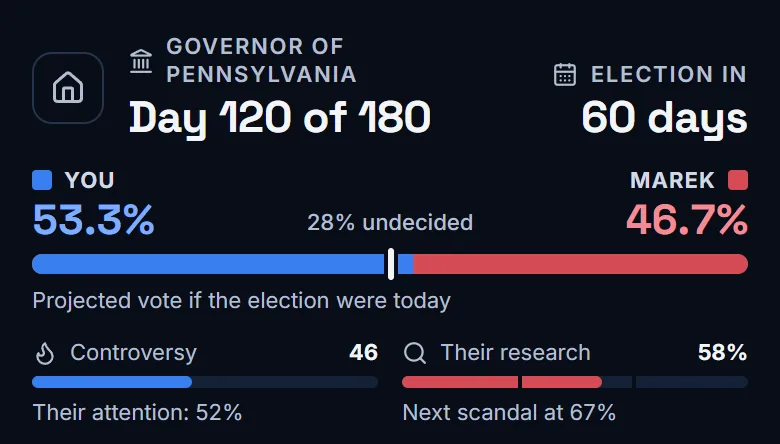
Bold moves add controversy. Controversy draws attack ads and opposition research, and research turns into scandals. Their rallies and ads show on the map, and you can answer an attack.
View full-size screenshot - 7
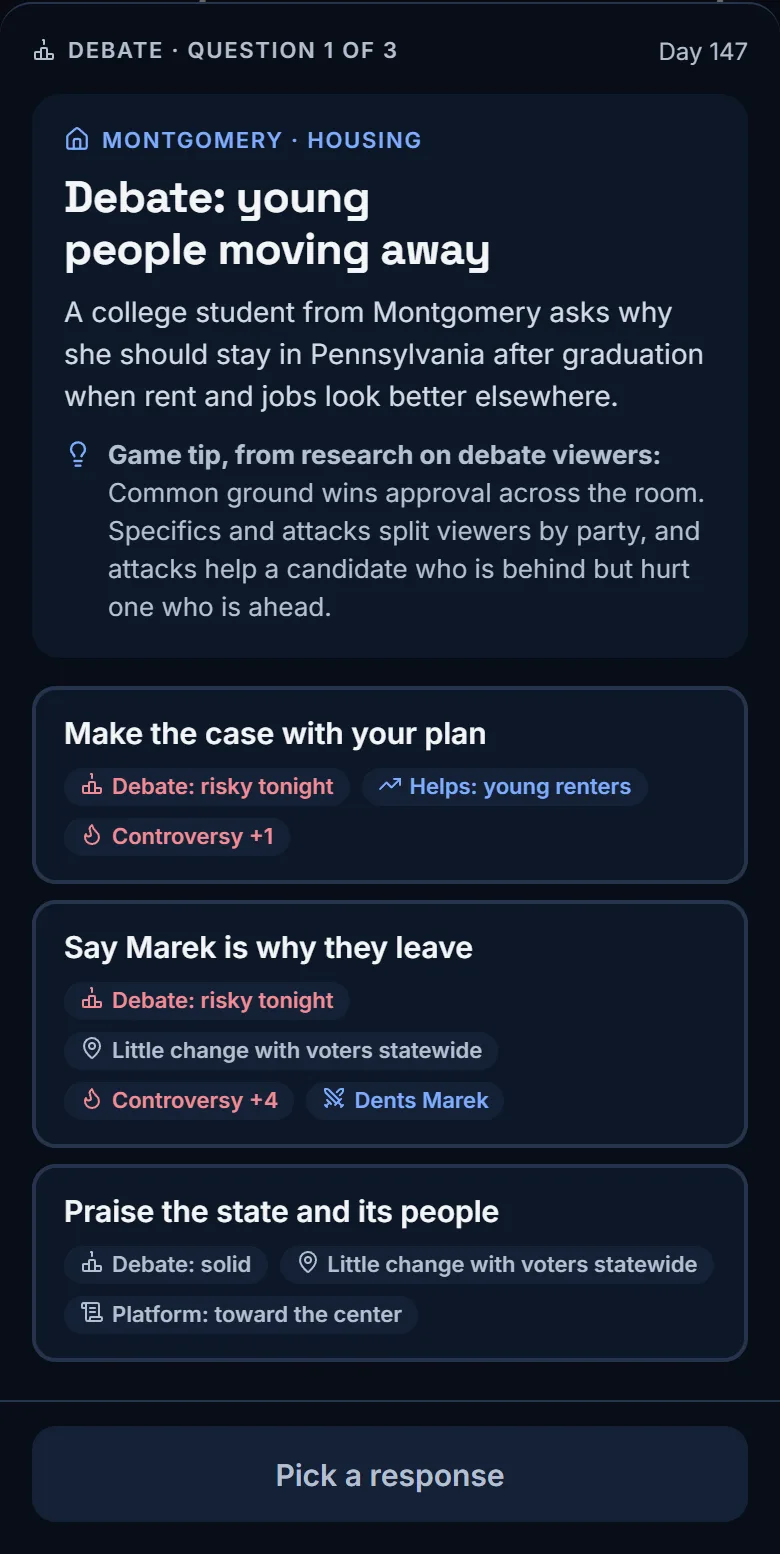
Win the debate
Races for mayor and up hold a debate in the final weeks. Common ground plays well with everyone; specifics and attacks split the room.
View full-size screenshot - 8
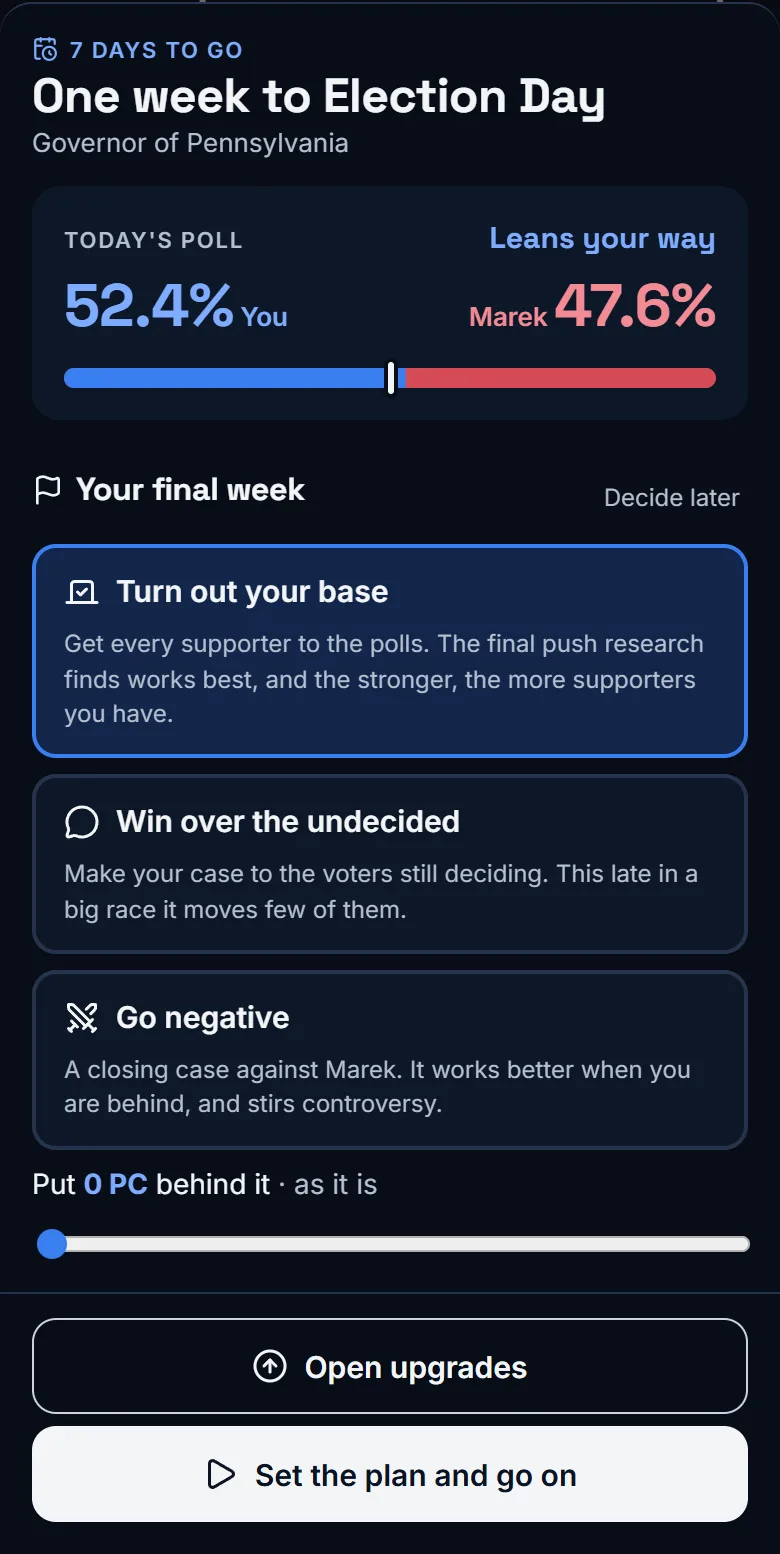
Plan your final week
A week out, pick your closing message: turn out your base, win over the undecided, or go negative, and put leftover Political Capital behind it.
View full-size screenshot - 9
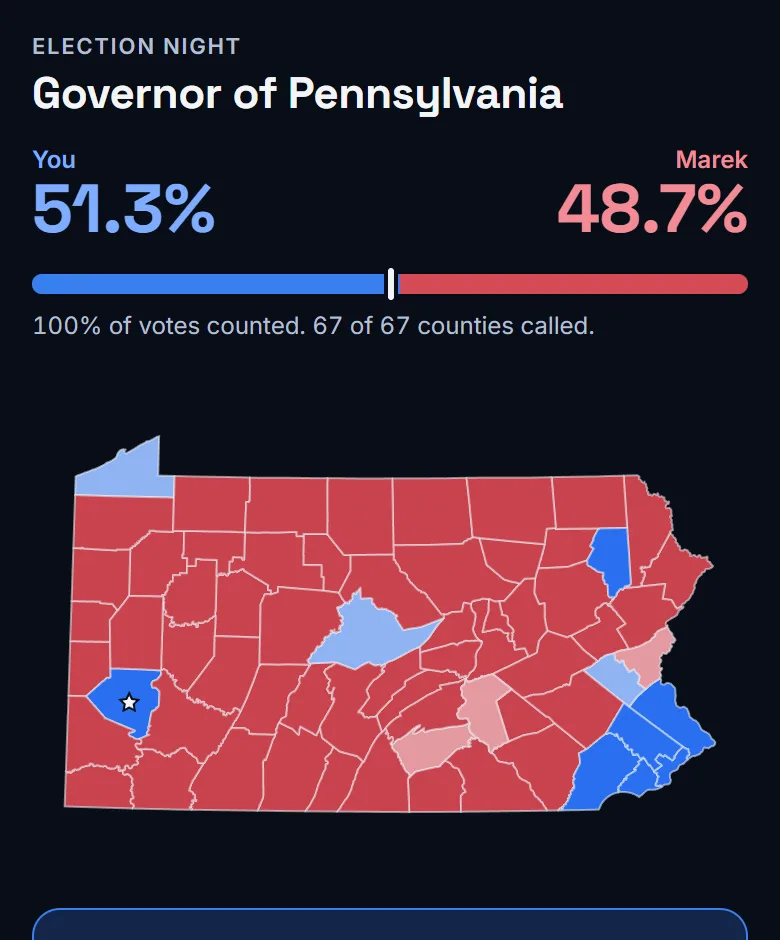
Win on Election Day
Every county reports on election night. Usually the most votes wins (a few states require a majority); for president it takes 270 of the 538 electoral votes.
View full-size screenshot - 10
Look back
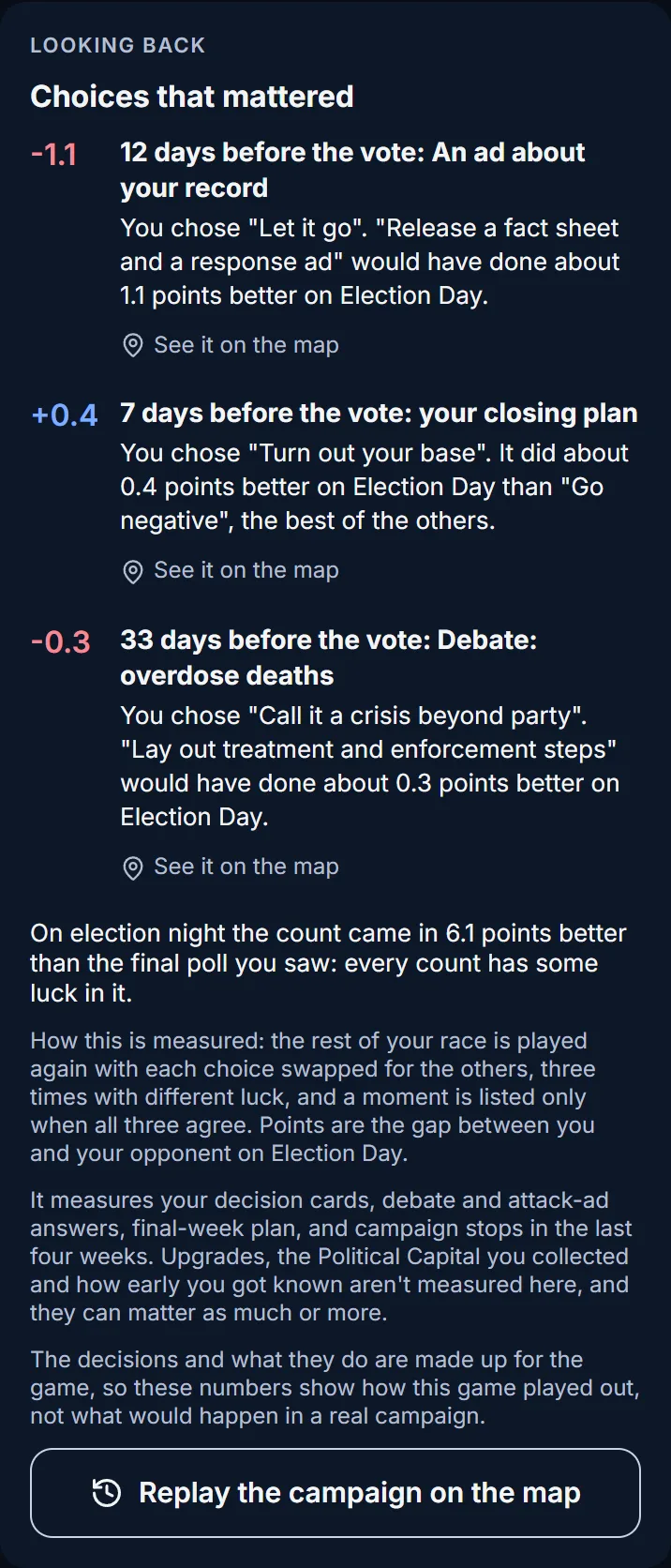
After the count, Looking back lists up to three of your choices that moved the result, each measured by playing the rest of your race again with the other options. It weighs decisions, answers, your final-week plan and late stops, not upgrades or spending. Replay the campaign plays the whole race back on the map.
View full-size screenshot
Reading the race screen
- Projected vote
- Your share if the election were held today. It moves as people get to know you and make up their minds.
- The map
- Support colors each place by who leads there; Who knows you shows where people have heard of you. The List button shows every place's numbers as a table.
- Controversy
- Bold moves raise it. The more of it, the more attention the other campaign pays you.
- Their research
- The other side digging into your record. Each time it reaches a mark, a scandal breaks; the meter says where the next one is.
- Political Capital
- What you spend on upgrades. Bubbles bring it in, so tap them before they fade.
- Campaign news
- Headlines about you and your opponent: their rallies, ads and fundraising, and where they are gaining in the polls.
- Speed and pause
- Pause, half speed, normal or double. The clock also stops while the upgrades are open and whenever a decision is waiting.
- Menu and saving
- The Menu button pauses the race, with sound settings, the race conditions and Save and exit. Your race saves itself in this browser; Resume on the main menu brings you back.
After the race
Election night calls each place in turn, then gives the verdict. Some races go to a runoff, a second round with just the top two, and some are counted by ranked choice, where the last-place candidate's voters move to their next choice.
Below the result, Looking back lists the choices that moved the result most (decisions, answers, the final-week plan and late stops; upgrades and spending aren't measured) and replays the campaign on the map (not yet after a runoff). A Daily Race also shows par: how the game's own practice campaign does in the same race, so you can tell a hard day from a bad one. Copy your result to share it, or challenge a friend to your exact race.
A career
A career starts with a seat on your hometown's council (or whatever your town calls it), then runs for mayor, governor or senator, and president. Win, and you serve a term: you keep two of four in-office cards (three after a surprise landslide), and what they do carries into your next race. Then run for the next office up, or for re-election, within each office's real term limits.
Three losses end a career. The career score grows with bigger offices, wider wins, landslides and Headwinds; a re-election counts for half.
Tips for your first races
- Spend your Political Capital. Upgrades are how you spread and win people over; whatever is left in the final week can go behind your closing message.
- Get known early. Door-knocking, local radio and social media carry your name, and a place has to know you before it votes for you.
- Campaign where the race is close. A stop puts your name in front of a place and its neighbors, and it counts most where the vote could go either way.
- Keep controversy in check. A rapid response team softens scandals and slows the other side's research.
- In a toss-up, platform planks, endorsements and get-out-the-vote can tip it.
- In the final week, turning out your base works best in most races, and more so the more supporters you have. On a city ballot with no party label, winning over the undecided can do as well or better, and a challenger taking on an incumbent may gain more by going negative: it depends on the race. Which plan you pick rarely decides a race on its own; the campaign before it counts for more.
- After a race, read Looking back: it shows which of your choices helped, and where another option would have done better.
More detail: every upgrade, voters and opponents, and the full guide.
The bigger game
A career ladder
Local office, then governor or senator, then president, or run again for the seat you hold, within real term limits. Three losses end it.
Your hometown sets the odds
Every county leans the way it really votes (Alaska's boroughs are estimated), so friendly ground is a head start.
Real election rules
Runoffs, ranked-choice counts and split electoral votes, where states really use them.
Nine candidates, staff to hire
Each candidate plays differently, and every hire is a trade-off.
Daily Race and challenges
One race a day for everyone, with a par to beat, and a link to send a friend your exact race.
Twelve scenarios
Real races set up to teach one rule each, from runoffs to the Electoral College, for up to three stars.
Headwinds and achievements
Five stacking challenge levels and twenty ways to prove it.
What's real
The places, offices and districts are real, and so are the rules and years for governor, Senate and president. Every county leans the way it really votes (Alaska's boroughs are estimated, since Alaska reports by legislative district). Town and neighborhood leans come from real 2020 precinct results (estimates from census data in Alaska and Hawaii), and most city and county races use one simple set of rules. The parties, candidates, events and decisions are made up, and the campaign is a game, not a forecast. See the data sources.
Go deeper
- Game guide
Every candidate, upgrade, voter group and challenge, listed from the tables the game runs on.
- Learn how US elections work
Plain-word explainers on the rules the game is built on, each with its sources.
- The 50 largest cities
How each big city elects its mayor and council: runoffs, ranked choice, party ballots and the next election.
- For teachers
How to use the game in a class period, and how it stays neutral.